A Note on Studio Studies — the drawings we publish before the houses exist
On the twelve market pages where you will find a "Selected work" card with a hand-drawn render beside it. Most of the houses shown there do not yet exist. They are propositions. Here is what that means — and what we are careful it does not mean.
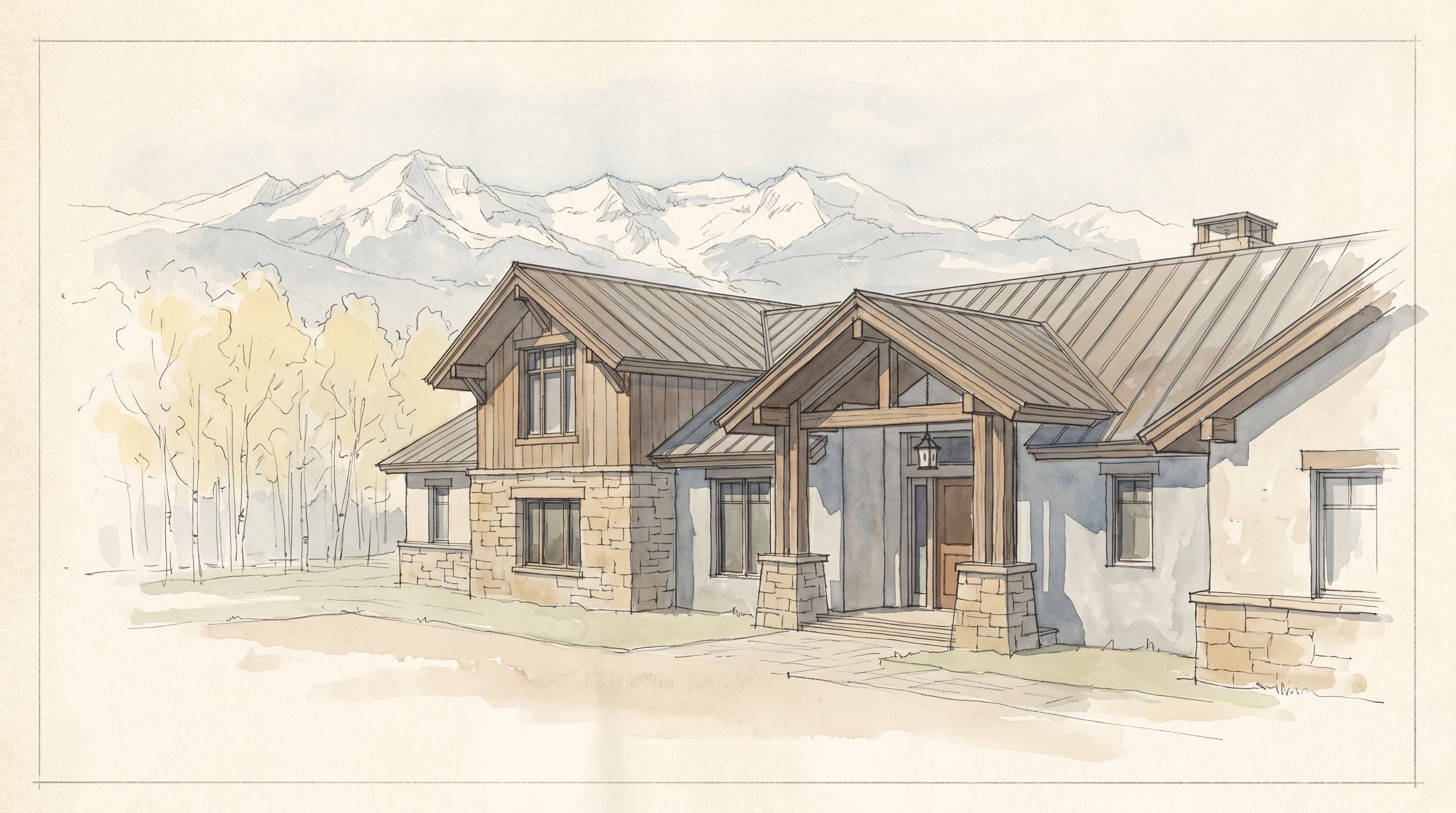
If you have come to our market pages — the twelve routes under /markets, from Montecito to Jackson Hole — you will have noticed that most of them now carry a "Selected work" card, and that the card shows a hand-drawn render rather than a photograph. If you have read the card closely, you will also have noticed that a small badge in its upper-left corner reads "Studio Study" and that a small caption at the bottom-left of the image reads "Architectural render · Studio Study."
This note is a short, plain explanation of what those cards are and are not, because we think a short explanation is owed to anyone who spends more than a moment with our work and notices that something about the presentation differs from the delivered projects further down our portfolio.
What a Studio Study is
A Studio Study is our design proposition for a specific market — the answer to the question, "what does Cerro bring to a home in the Palisades, in Rancho Santa Fe, in Aspen, in Jackson Hole?" It is named. It is located to neighborhood precision. Its materials are specified. Its collaborators are referenced. Its imagery is commissioned. In every respect except one, it is built to the same standard as the delivered projects elsewhere in our portfolio.
The one respect is the essential one: a Studio Study has not yet been built. It may be on the boards — in development with a client and an architect — or it may be a representative proposition the studio has authored ahead of any particular commission. Either way, we do not photograph the home and present it to you as finished work. We commission an architectural watercolor render, in a tradition closer to Peter Zumthor's Therme Vals drawings or Marc Appleton's Montecito studio studies than to anything photographic, and we present that.
What a Studio Study is not
A Studio Study is not a render dressed up as a photograph. It is not an AI image posing as a delivered home. It is not a portfolio entry claimed as built work. And — this is the part we take most seriously — it is not an attempt to signal capability in a market where we do not yet deserve one.
We have delivered sixteen projects, all of them on the Central Coast. When you visit /markets/central-coast and see Casa de la Cresta, you are looking at a home we designed and finished — photographs taken on site by a photographer we hired, rooms we can show you in person if you call. When you visit /markets/aspen and see Red Mountain Restraint, you are looking at a watercolor of a home that exists only as a Cerro proposition for what an Aspen commission would look like in our hands. The two categories are visually, legibly, structurally different — and we have built the site so that you cannot confuse them unless you try.
The three disclosures
A Studio Study signals itself in three ways at once — visually, through interface, and through the metadata that search engines read.
The imagery is the first disclosure. Every Studio Study is rendered as a hand-drawn watercolor or presentation drawing in a style that cannot be mistaken for a photograph. Pencil linework is visible on every architectural edge. Paper grain shows through the wash. Color bleeds into shadow the way watercolor does, not the way light does. The drawing reads as the sort of study pinned to a drafting board during a client review — warm, considered, and evidently made by hand.
The interface is the second disclosure. A persistent badge in the corner of every Studio Study card and every Studio Study detail page reads "Studio Study · Cerro Studio proposition" with the projected year beneath. A separate caption on every image reads "Architectural render · Studio Study." A call-out box inside each Studio Study detail page explicitly states that the page is a proposition rather than a delivered project, and invites you to write to us if a home in that market is on your mind. You do not have to read the fine print — the signal is at the top of the page.
The metadata is the third. Every Studio Study page carries structured data declaring its status to search engines, so that a crawler understands — before a human has rendered the page — that this is a design proposition and not a delivered home. The sitemap weights Studio Studies slightly lower than delivered work. The page title is prefixed accordingly. We have done this because we care whether an AI summarizing our work describes it accurately.
Why we publish them
The honest answer is that Cerro is expanding, and expansion requires a certain kind of honesty about trajectory. We have opened a satellite in Los Angeles and have plans for a Northern California studio in 2027. We now serve — by travel, from the flagship — markets as far east as Jackson Hole and as far south as Rancho Santa Fe. But we have not yet delivered work in most of those places. An empty "Selected work" panel on every new market page would be technically honest and practically useless. A panel full of invented completed projects would be dishonest.
The Studio Study is our answer to that gap. It lets us say clearly, on every market page: here is what Cerro would bring to a project in this market, and here are the collaborators, materials, and disciplines we would bring with it. Not a promise. Not a closed case. A proposition — in the oldest and most architectural sense of the word.
Their natural end
A Studio Study's natural end is to be replaced — not preserved, not archived, not kept in parallel. When we deliver a project in Aspen or Palisades or Paradise Valley, the Studio Study for that market is taken down, and the delivered project takes its slug, its market-page position, and the corner of our portfolio that used to belong to the proposition. The render is replaced by photography. The badge disappears. The copy shifts from future-conditional to past-and-present tense. The disambiguating schema is removed.
We expect the Studio Studies to thin out, market by market, over the next five years. Some will sign and become the project they always proposed to be. Others will be refined, retired, or replaced by something better. That is how the category is meant to work. In the meantime — here is what we would do if you called.
A proposition is not a promise. But it is a statement of how we would answer the question, rendered with the same discipline we would bring to the answer itself.
Why We Always Come Back to Lime Plaster →
It breathes. It shifts with the light. It records the hand that applied it. In a world of perfectly flat drywall, lime plaster is an act of faith in imperfection.
What Luxury Means Here →
In most places, luxury is something you add. On the Central Coast, it is something you subtract. A walk at dawn. A long table at dusk. A house that disappears into the life inside it.
Send us your plans. We'll send back a review.
If you're early in a project — schematic, design-development, or permit set — send your drawings and we'll return a written review within five business days, free.