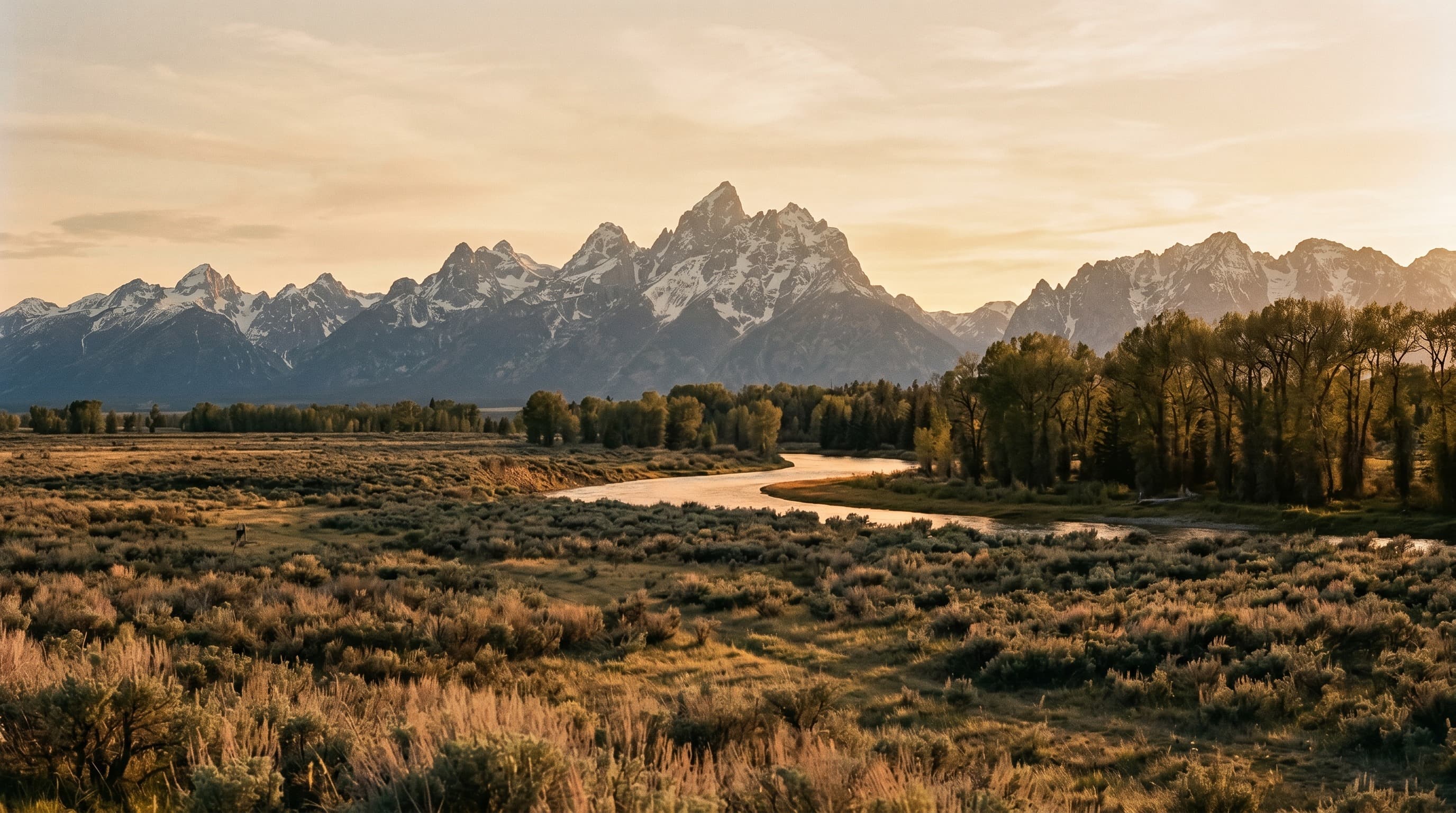
Jackson Hole & Teton Valley
Shooting Star to Wilson. Agrarian restraint, warm mountain trad — the JLF sensibility made permanent.
Teton County, Wyoming.
Jackson Hole is the Mountain West's most architecturally-disciplined luxury residential market. Teton County's Land Development Regulations keep density low, scale modest, and aesthetic coherence unusually intact; JLF Architects' Jonathan Foote lineage has set a regional standard of restraint that the best new work still measures itself against. Our sensibility belongs here — specifically in the warm-traditional and agrarian-ranch lane, where craft density, material honesty, and indoor-outdoor discipline are the design problem. We are not the firm for mountain-modernist glass-box work (Carney Logan Burke and Stephen Dynia own that conversation); we are the firm for the collected, layered, patina-first house that reads as rooted even when newly built.
Our Jackson Hole practice is travel-delivered from Montecito (and later NorCal), with weekly principal presence during active construction and a retained local project manager triggered once two concurrent projects are past schematic design. Flights from SBA route via SLC or DEN to JAC; the cadence requires disciplined scheduling but is manageable on the Shooting Star / West Bank trophy tier where project budgets reward it.
The trophy tier here is unlike any other market. Shooting Star inside Teton Village runs $40M–$80M for custom estates; the West Bank along the Snake — Wilson, Moose, Indian Springs Ranch — routinely trades $20M–$100M+ for ranch-character compounds on meaningful acreage. Spring Creek Ranch and 3 Creek Ranch are the guard-gated mid-tier trophy band at $10M–$30M. Teton Village proper (excluding Shooting Star) covers the $6M–$20M ski-in programs. Jackson itself preserves a historic downtown with adaptive-reuse potential and mixed-use residential opportunities.
Our collaborator bench leans toward the JLF orbit and the firms sharing its sensibility — Ellis Nunn for traditional ranch, CLB and Ward + Blake for projects where a more modernist lead is appropriate. The builder class is small and deeply-held — OSM, Big-D Signature, New West Building Company, and Teton Heritage Builders are the names that carry at this scale.
Design character.
JLF-Aligned Restraint
Material honesty, craft density, unforced relationship to the site — the Jonathan Foote lineage translated through our Montecito discipline. Quiet houses for quiet families.
Agrarian Ranch Vernacular
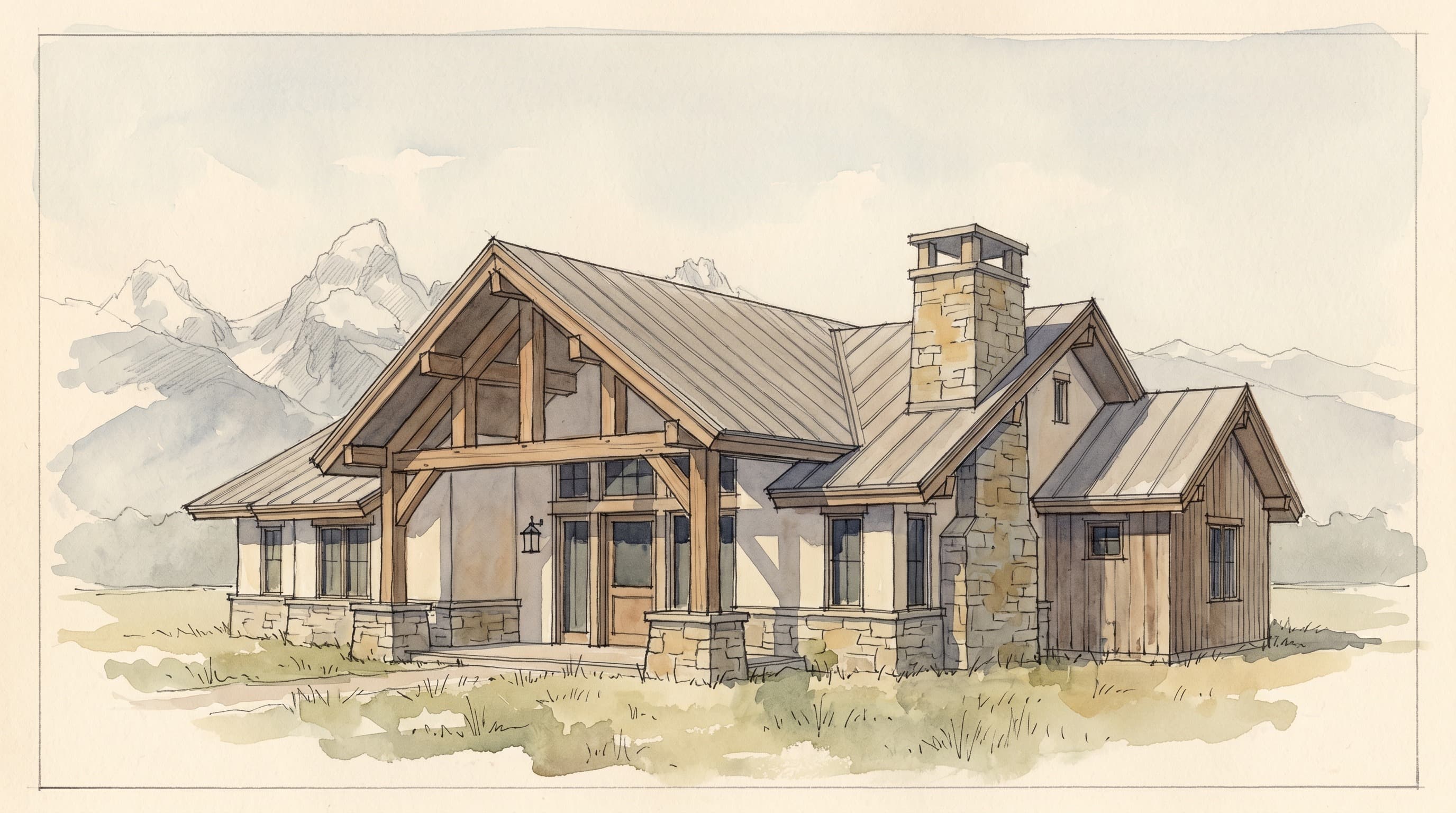
Barn-derived programs — stone hearth, timber frame, ample covered porch, working-ranch aesthetic. The Western Home Journal idiom, refined without sanitizing.
Snow-Country Detail
Standing-seam metal or patinated copper roof, deep eaves engineered for Teton snow load, dog-trot entries, mud-and-ski rooms at residential scale — these are first-class design problems, not checkboxes.
Indoor-Outdoor Year-Round
The Teton climate permits indoor-outdoor living six months; our design extends it through nine with covered loggia, outdoor hearth, and mechanical accommodation for winter use.
Neighborhoods and sub-submarkets.
The trophy anchor. Ski-in/ski-out, guard-gated, $40M–$80M+ custom estates. Small lot count; every sale is significant.
Ranch-character estates along the Snake River. Acreage parcels, private, $20M–$100M+ trophy band. Our most natural aesthetic fit.
Butte-top gated community overlooking the valley. $10M–$30M, mixed architectural vocabulary, view-dominant.
Private fly-fishing community south of Jackson. $10M–$25M, ranch character, limited inventory.
Ski-in condo and townhouse stock plus custom homes adjacent to the resort. $6M–$20M.
Gated ranch communities with large-acreage parcels. $15M–$40M custom-home program.
Preserved late-19th-century streetscape. Mixed-use and adaptive-reuse opportunities, select residential at $4M–$12M.
What makes Jackson Hole Cerro.
The specific materials, methods, and moves we bring to projects in this market — tuned to its climate, its vernacular, and the clientele that builds here.
Jackson Hole publications.
On the ground.
What people ask about Jackson Hole.
What is the per-square-foot cost of luxury construction in Jackson Hole?
Total turnkey luxury construction in Jackson Hole ranges from $1,500 to $3,500 per square foot in 2025–26, with the median project landing near $2,400 per square foot for elevated-luxury finish. A 5,000 sqft mid-tier project runs approximately $12M turnkey — including envelope, structure, MEP, interiors, FF&E, landscape, and contingency.
Which architects work in Jackson Hole?
The leading luxury residential architects in Jackson Hole include JLF Architects (Jonathan Foote lineage), CLB Architects (Carney Logan Burke), Ward + Blake Architects, Stephen Dynia Architects, and others. Cerro Studio collaborates with these firms on shared projects — leading interior architecture, materials, FF&E, and the long-form client relationship while the architect leads envelope, structure, and the architectural review process.
Who are the top luxury builders in Jackson Hole?
Leading luxury custom-home builders in Jackson Hole include OSM (On Site Management / OSM Construction), Big-D Signature, New West Building Company, Teton Heritage Builders, and others. Cerro Studio works alongside these builders on site — material reviews, change orders, the punch list, and final styling — to ensure the design intent reaches occupancy.
What is the typical project investment range in Jackson Hole?
Luxury residential projects in Jackson Hole typically fall in the $8M – $60M+ range for the kind of work Cerro Studio leads. Smaller in-town renovations and additions run below the lower end; trophy estates with full programs (pool, cellar, ADU) can exceed the upper end. These are total turnkey project budgets, not just construction or design fees.
What architectural style does Cerro Studio bring to Jackson Hole projects?
Our Jackson Hole work is rooted in the regional vernacular — JLF-Aligned Restraint — adapted with our material lexicon: Hand-hewn timber frame — Douglas fir, reclaimed oak, salvaged barn timbers; Native moss rock and rundle stone — wall, hearth, and exterior base; Standing-seam metal or naturally-patinated copper roof. We design to the parcel, not to a stylistic template.
How does Cerro Studio deliver projects in Jackson Hole?
Jackson Hole is served via travel-delivered from nearest studio. Engagements are principal-led and include weekly site visits during critical construction phases, biweekly cadence otherwise. Every inquiry is read by the principal designer and the studio manager, with a personal response within five business days.